
The excerpt below is from the The Age of Wood: Our Most Useful Material and the Construction of Civilization, by Roland Ennos (Scribner, 2020).

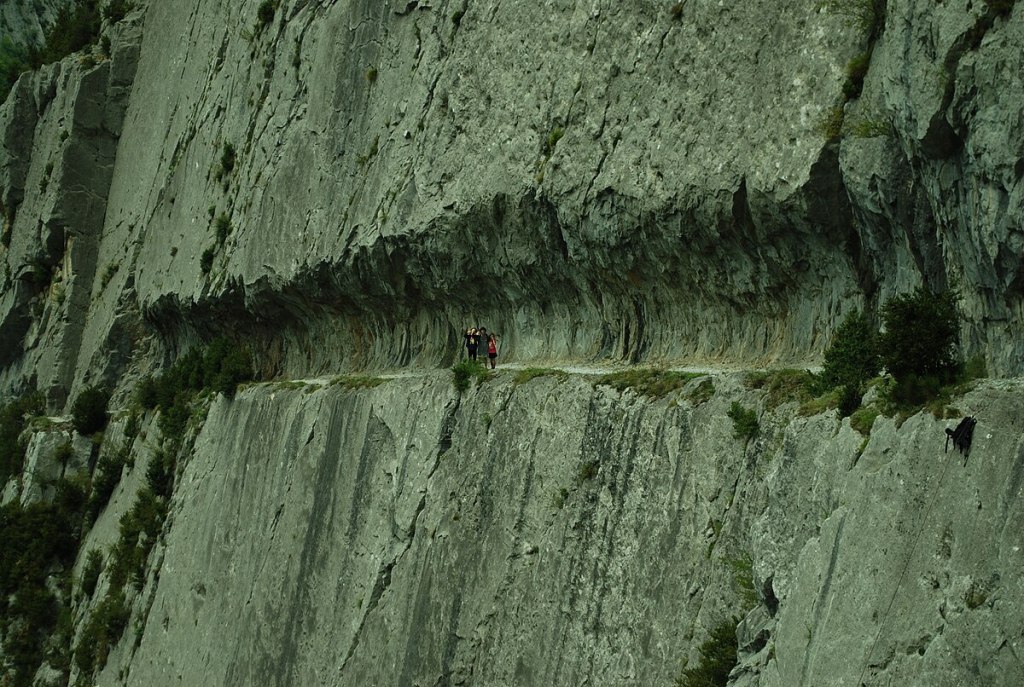
Many years ago, toward the end of an arduous walking tour of the French Pyrenees, my brother and I stumbled across an engineering feat that had helped change the course of human history and shape the modern world. As we made our way down from the peaks to the village of Ersaut, the route took us from alpine meadows to the conifer forests of the Vallée d’Aspe. The path, which had been broad and easy to follow, suddenly changed. As the river valley continued to drop, the path maintained its level, but only by cutting into the walls of an almost sheer rock face. Soon we were walking along a narrow ledge perched precariously six hundred feet above the trees and foaming river in the Gorge d’Enfer below. The path continued like this for almost a mile before the gorge finally opened out, and we descended down to the level of the river and once again felt safe. Only then did a sign helpfully tell us that we had navigated the Chemin de la Mâture. Why had such a spectacular path been built in the middle of nowhere? And what was mâture?
The answer lies in the rivalry that developed in the eighteenth century between the two emerging superpowers of the Western World, France and Britain, and provides just one of the more striking examples of the way wood has helped shape the human story. With the two nations vying for power and influence over their developing colonies and territories in the Caribbean and North America, an arms race started as they built up their navies. Both nations strove to build bigger and more heavily armed ships of the line, capable of acting as firing platforms for up to 100 huge cannons, which could batter other ships and shore defenses into submission. But both countries came up against the same problem; how could they access enough trees to build their ships? The problem was not the lack of wood itself. France in particular had large areas of forest, which covered around 30% of the country. The problem was the lack of trees tall and straight enough to make the 100-to-120-foot masts of the ships. Most forests in Europe were already being managed, and it was becoming harder to find areas of primary forests where tall trees could still be found. For France the answer lay in the wilds of the Pyrenees, where stands of huge fir trees still stood. The engineer Paul-Marie Leroy put forward his plan to extract trees from the previously inaccessible Vallée d’Aspe by cutting a daring path through the edge of the cliff. The path was completed in 1772 and named the Chemin de la Mâture (literally the Mast Road). Soon masts and other timbers were being hauled down the new path, before being rafted down to the sea. France’s supply problems were fixed, at least temporarily.
In Britain the problem of obtaining masts was even more acute. The country had a tree cover below 10 percent, and its forests had long before been put under management. Few conifers grew there, and no trees tall and straight enough to be made into ships’ masts. Even by the sixteenth century, Britain had been forced to obtain almost all its masts from the countries adjoining the Baltic Sea. The problem was that the fleets of its northern rivals, Holland and Sweden, were always threatening to cut off this supply, and in any case tall trees were becoming scarcer and more expensive. Britain turned to its American colonies, where the old-growth forests of New England contained huge, straight-trunked eastern white pine trees in seemingly limitless numbers. From the mid-seventeenth century onward these trees, which could grow up to 230 feet tall with a diameter of over five feet, became the tree of choice for the British navy; Samuel Pepys, the naval administrator, mentions the trade several times in his famous diary, rejoicing on December 3rd, 1666, when a convoy carrying masts managed to evade a Dutch blockade:
There is also the very good news come of four New England ships come home safe to Falmouth with masts for the King; which is a blessing mighty unexpected, and without which, if for nothing else, we must have failed the next year. But God be praised for thus much good fortune, and send us the continuance of his favour in other things!
Unfortunately, in seeking to secure their supply of masts, the British government made a series of policy blunders that were to have disastrous consequences. They had difficulty buying tree trunks on the open market because the colonists preferred to saw them up for timber. this was after all a much easier way of processing them, considering their huge size, rather than hauling the unwieldy trunks for miles down to navigable rivers. The British could have bought up areas of forest and managed them themselves, but instead, in 1691 they implemented what was known as The King’s Broad Arrow policy. White pine trees above twenty-four inches in trunk diameter were marked with three strokes of a hatchet in the shape of an upward-pointing arrow and were deemed to be crown property. Unfortunately, this policy soon proved to be wildly unpopular and totally unenforceable. Colonists continue to fell the huge trees and cut them into boards 23 inches wide or less, to dispose of the evidence. Indeed wide floorboards became highly fashionable, as a mark of an independent spirit. The British responded by rewriting the protection act to prohibit the felling of all white pine trees over 12 inches in diameter. However, because trees were protected only if they were not “growing within any township or the bounds, lines and limits thereof,” the people of New Hampshire and Massachusetts promptly realigned their borders so that the provinces were divided almost entirely into townships. Many rural colonists just ignored the rules, pleaded ignorance of them, or deliberately targeted the marked trees because of their obvious value. The surveyors general of His Majesty’s Woods, employing few men and needing to cover tens of thousands of square miles, were almost powerless to stop the depredations of the colonists, and the local authorities were unwilling to enforce an unpopular law. The situation reached a crisis in 1772, exactly when the Chemin de la Mâture was being completed, with the event known as the Pine Tree Riot.
The event was precipitated when sawmill owners from Weare, New Hampshire, refused to pay a fine for sawing up large white pines, and Benjamin Whiting, sheriff of Hillsborough County, and his deputy, John Quigley, were sent to South Weare with a warrant to arrest the leaders of the mill owners, Ebenezer Mudgett. However, before they could complete their task, Mudgett led a force of twenty to forty men to assault them at their lodgings, the Pine Tree Tavern. Their faces blackened with soot, the rioters gave the sheriff one lash with a tree switch for every tree being contested, cut off the ears and shaved the manes and tails off of Whiting’s and Quigley’s horses and forced the two men to ride out of town through a gauntlet of jeering townspeople. Eight of the perpetrators were later punished, but their fines, twenty shillings each, were an indication of the weakness of British authority.
News of the riots spread around New England and became a major inspiration for the much more famous Boston Tea Party in December 1773. The Pine Tree Flag even became a symbol of colonial resistance, being one of those used by the revolutionaries in the ensuing War of Independence. Designed by George Washington’s secretary Colonel Joseph Reed, it was flown atop the masts of the colonial warships.
The start of the Revolutionary War cut off the supply of masts for the Royal Navy from New England. The British were forced to use smaller trees from the Baltic for their masts, and had to clamp together several trunks with iron hoops to construct ‘made masts.” This arrangement was at best unsatisfactory, and many British ships spent most of the ensuing war out of action in port with broken masts. To make matters worse, the colonists started to sell their pines to the French, who had opportunistically sided with the rebels. The French defeated the British in important naval conflicts — such as the Battle of Granada in 1779, the most disastrous British naval defeat since Beachy Head in 1690 — while British naval actions against the colonists themselves proved indecisive. Without Britain’s usual naval superiority, America prevailed and became independent in 1783. What would become the world’s most powerful nation had been born. Britain would soon regain its Naval superiority, managing to replace its supplies of masts by using trees from its other dominions, Canada and eventually New Zealand, but the world would never again be the same. Thus is a turning point in geopolitics glimpsed in a path hewn out of a cliff in the Pyrenees.
To learn more about the Great Mast Crisis, read the remainder of this prologue.
 Tree People of Walla Walla