
Revised: February 2023
Revised: August 2023
Revised: November 1, 2024
If you were asked to name a cedar, and you responded with Western Redcedar, you’d be wrong. It’s not a true cedar.
If you said Incense Cedar, you’d be wrong again.
Alaskan Yellow-cedar, Nootka cedar: wrong again.
Port Orford Cedar: Wrong
Eastern Red Cedar, Eastern White Cedar: WRONG!
Mountain Cedar, Persian Cedar, Bermuda Cedar: Wrong, Wrong, Wrong. None of these are true cedars.
There are only three True Cedars, none of which are native to North America.
Atlas Cedar
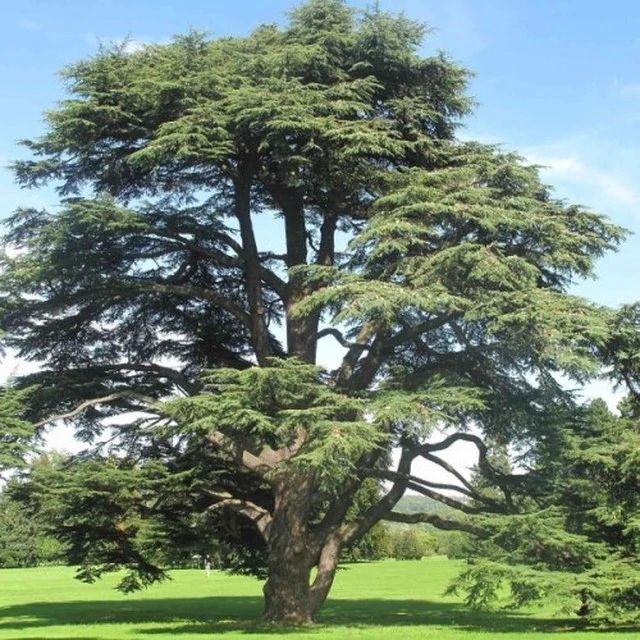
Cedar of Lebanon
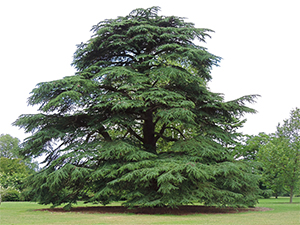
Deodar Cedar

The native range of the True Cedars is the southern and eastern areas of the Mediterranean basin, reaching as far east as the western mountains of the Himalayas. When we traveled in Tunisia in the spring of 2000 we tried (unsuccessfully) to find guides to take us across the border into Algeria. We hoped to see the Atlas cedar in its native range, the Atlas Mountains of North Africa.

The taxonomy of the cedars is controversial. Some dendrologists claim that a fourth True Cedar exists, the Cedrus brevifolia, which grows only in the Troödos Mountains of central Cyprus. Others consider the Atlas cedar a subspecies of Cedrus libani. To further complicate matters, recent studies argue that all the cedars are a single species, Cedrus libani, and the others are subspecies.
All true cedars have all been heavily exploited, primarily for firewood, and are now endangered in their native ranges.
Notes
We have drawn from five articles by Tom Christian from the website Trees and Shrubs Online (treesandshrubsonline.org/articles/cedrus/. . . . ). Christian, T. (2020). Accessed 2021-05-16 and on numerous occasions thereafter.
Trees of God: The story of the mighty cedar by Jack Watkins; Country Life, October 20, 2024. This source is invaluable for those interested in learning when and how the different Cedrus species were introduced to western gardens.
Related pages
Boboli Garden, Florence, 2009

Boboli Garden in Florence, Italy, was established by the Medici family in 1553 and opened to the public in 1766. Here Gayle is identifying an Atlas cedar for two awestruck visitors.
 Tree People of Walla Walla