
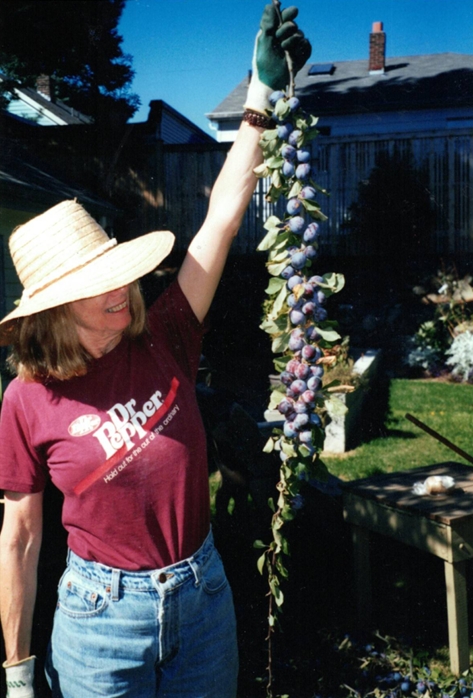
Gayle with a cluster of Italian Plums. Prunus domestica are native to the Caucasus and were brought to the Mediterranean in antiquity, probably between the sixth and third centuries BCE. The Knights of the First Crusade (1099 AD) spread the fruit throughout Europe, first in France, then in Germany, until it reached Denmark and Southern Scandinavia.
North American Native Plums
Prunus nigra
Prunus nigra, often called the Black plum or Canadian plum, is our northernmost native plum. The Black plum was first recorded along the St Lawrence River in 1535 by Jacques Cartier, on his second voyage in search of the legendary Kingdom of Saguenay. The mythical kingdom was reputedly rich in gold and diamonds, and some of the inhabitants knew how to fly.
Cartier ventured inland as far as the Native American villages of Stadacona (Quebec City) and Hochelaga (Montreal). It was during this cultural exchange that the Native Americans brought the Black plum to Cartier and his crew.
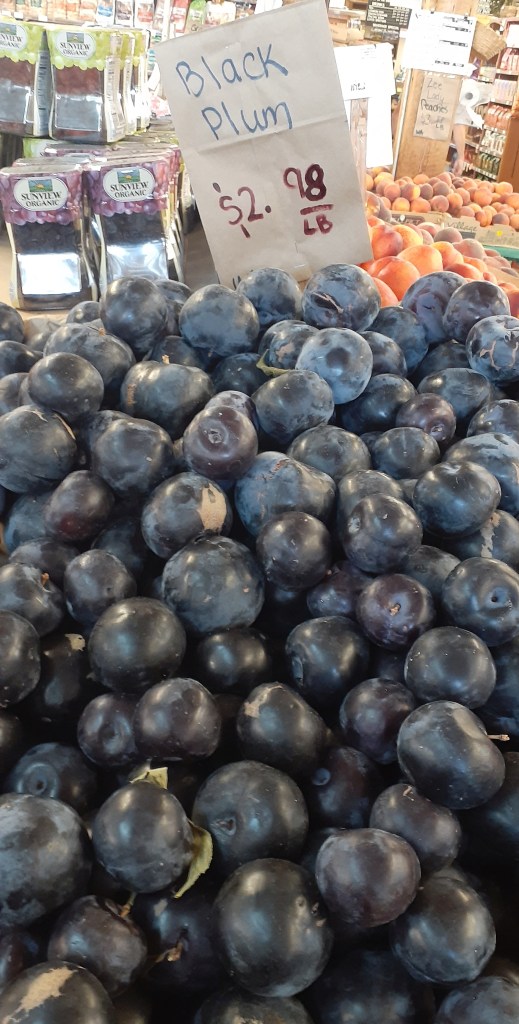
The fruit of the native Black Plum is not black; the tree is named for its dark branches. The standard black plums sold in Western supermarkets is usually Prunus salicina (Japanese plum) or a cultivar of Prunus domestica, such as ‘Black Amber’ or ‘Black Splendor’.
The American Plum
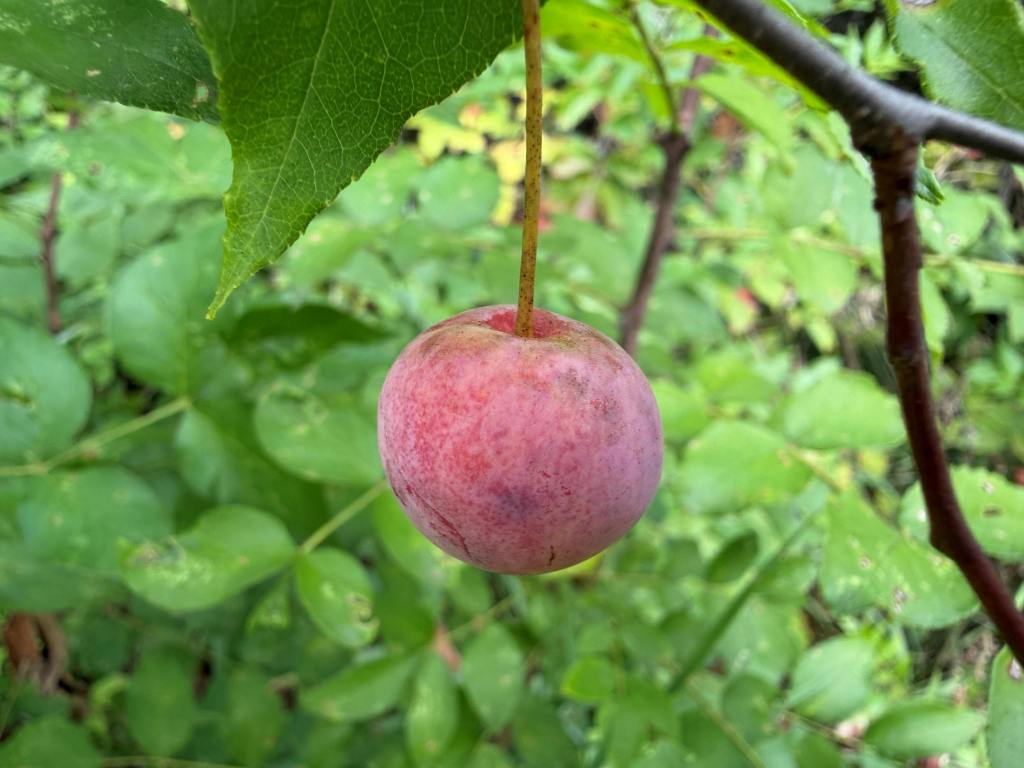
The American plum (Prunis americana) is recognized by botanists and forestry databases as the most common and broadly distributed native wild plum species across North America. The geographic range spans across much of the United States and southern Canada. it thrives from Saskatchewan and Quebec down to Florida and Arizona and grows wild in at least 43 U.S. states, thriving in hardiness zones 3 through 8.
The little beauty below was found along St. Cloud’s Beaver Island Trail in Minnesota in the late summer of 2026.
Minnesota Star Tribune
All 15 Native Plums
Altogether there are fifteen native plums in North America, including the two listed above. All our native plums are edible, some more palatable than others, and they come in all sizes. Some grow on bushes, like the Peachbush Plum, which grows to a height of only three feet. Towering over the Peachbush is the Hortulan, which grows to a stately thirty feet. The fruit ranges from the miniscule 1/4 inch (the Chickasaw Plum) to the enormous Wild Goose Plum.
One native, the Beach plum, thrives in salty dune sand. The Chickasaw plum is one of the smallest of our native plums. The Appalachin plum has nothing to recommend it. The Havard plum, Murray’s Plum, and the Peachbush Plum, are all found only in Texas. The Havard was first identified as a species by Dr. V. Havard, United States Army, in July, 1883, at Bone Springs near the Chisas Mountains.
The Klamath Plum is the only native plum growing in the Pacific US states. The Mexican Plum is the only native that grows like a cultivar, with a single trunk and without suckering. Murray’s Plum is the rarest of our native plums; there’s no documentation of the fruit since it was first scientifically described 1n 1928. The Wild Goose Plum produces fruit that is yellow or orange!1
Cherry Plums
In 1878 Naser al-Din Shah Qajar (the Shah of Persia) chose to visit the Exposition Universelle (World’s Fair) in Paris. While in Paris the Shah recruited Ernest François Pissard, a French horticulturist, to serve as the head gardener at the Marble Palace in Tehran. Shortly after his appointment, Pissard moved to Tehran to overhaul the palace grounds.
One day while surveying the gardens Pissard looked carefully at one of the Myrobalan Plums, commonly known as Cherry Plums. Upon closer inspection he discovered a single mutant sport branch. Unlike the rest of the tree, this specific branch bore striking, dark reddish-purple foliage. Intrigued by its dramatic ornamental value, Pissard successfully propagated the branch using cuttings. In 1880, Pissard sent specimens of this newly propagated clone from Tehran to France.
The plant arrived in Paris and was formally described by the French botanist Élie-Abel Carrière, who named the cultivar Prunus cerasifera ‘Pissardii’. By the late 1880s, the tree had crossed the Atlantic and exploded in popularity across North America. Virtually all modern purple-leaf plum trees planted in Western landscaping today are direct or indirect descendants of the branch found by Ernest Pissard in the Shah’s garden.2
Cultivars of the original Purple leaf plums, often selected for abundant white or pink flowers, are among the most common street trees and ornamentals in North America. The tree is now so well established in North America that there are dozens of cultivars, as described by Arthur Lee Jacobsen.3
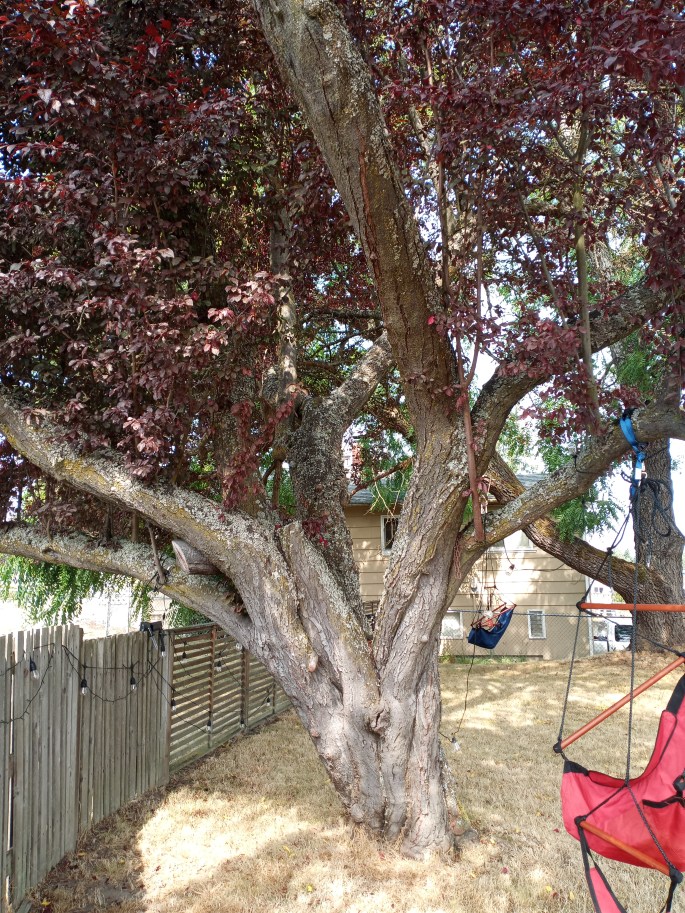
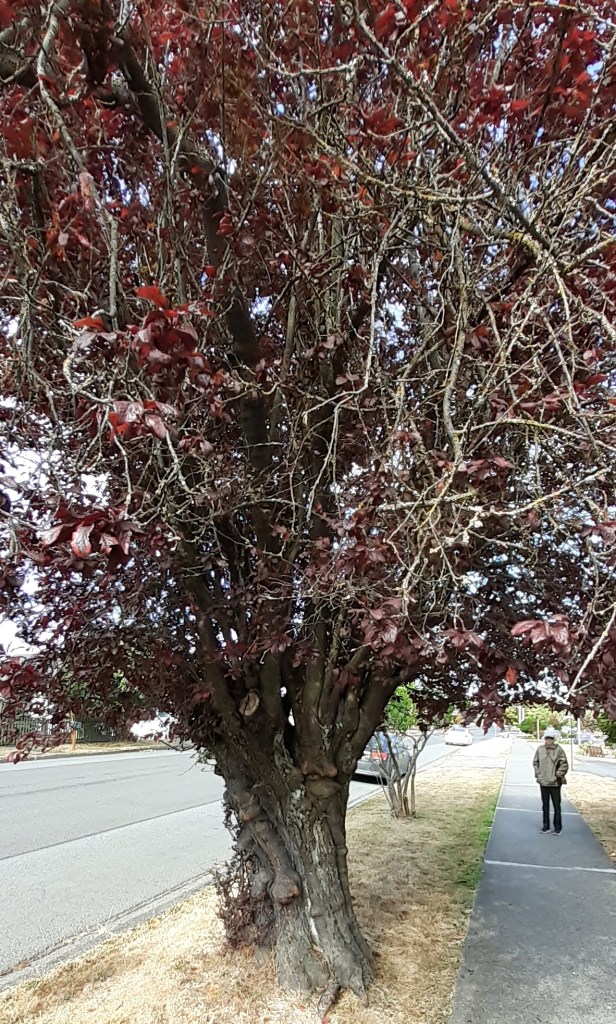
Below, two veteran Myrobalan Thunderclouds found on the Olympic Peninsula.4
Relict Plums
It could hardly qualify as a tree. More of a scruffy bush, really.
We’d passed it many times on our walks and hadn’t given it a second thought. What brought it to our attention on this occasion was the rotted fruit sticking in the soles of our boots.
Dozens of small, dark plums, no larger than a button, littered the ground. This plum was more like a plum the first nations people would have gathered, or the bears would have eaten and dispersed before the settlers came to this valley.
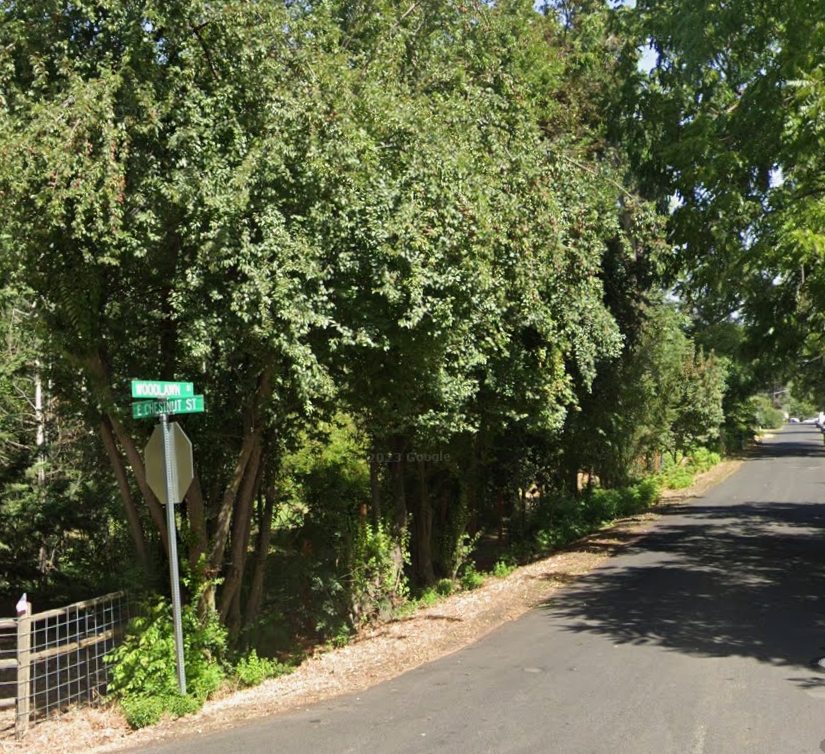
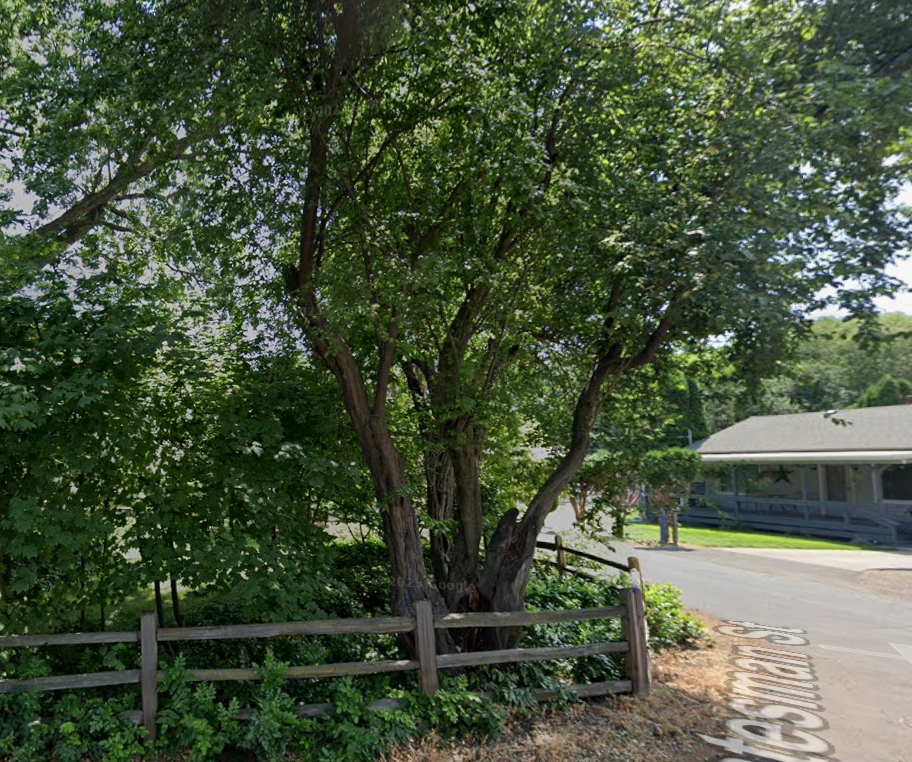
To complicate matters, another relict plum grows not far away. Our friend Mike has curated a private arboretum on his property. One of the trees he inherited when he bought the property 50 years ago, is a plum that was already old when he bought the property.
Italian Plums
You can count yourself among the fortunate few if you find an Italian plum tree. This once prolific tree is now a rarity, found mostly in abandoned orchards or old homesteds. If you find one, record the GPS coordinates, and tell no one.
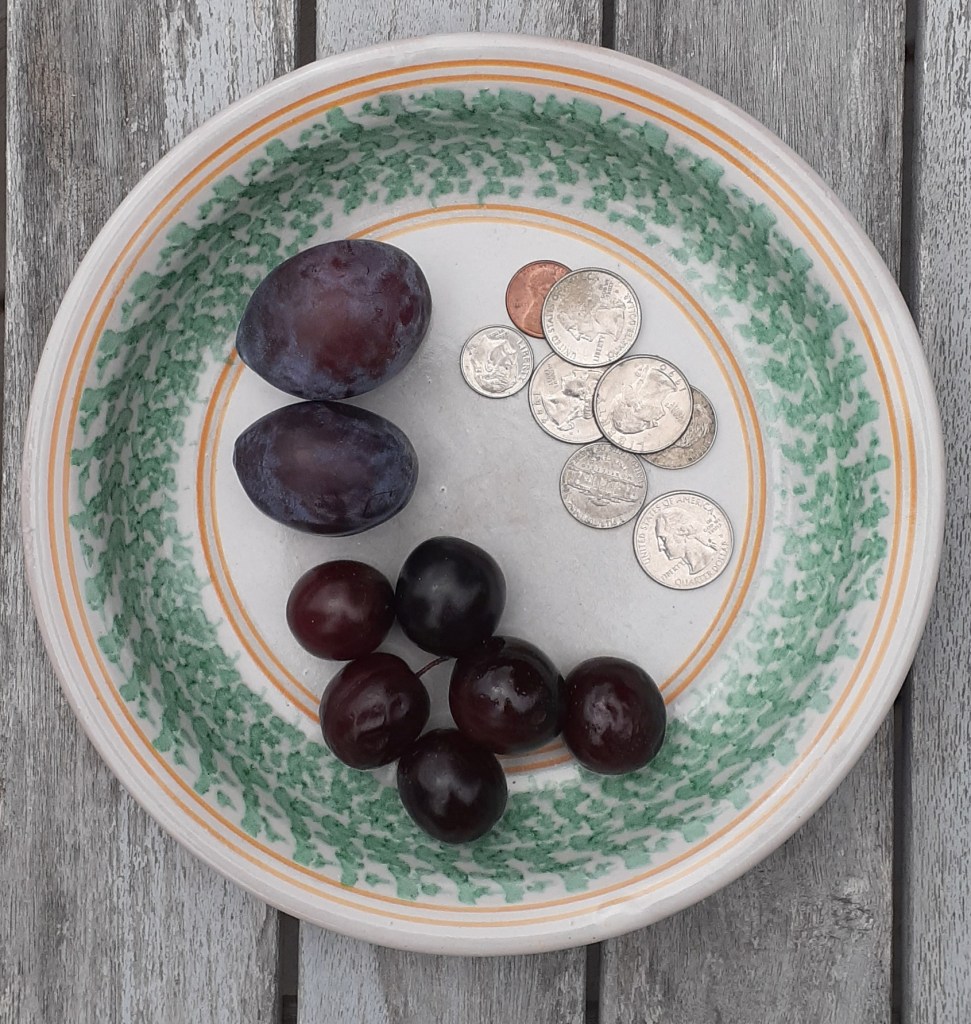
The image below shows both Italian Plums and Cherry Plums for comparison:
Recipes
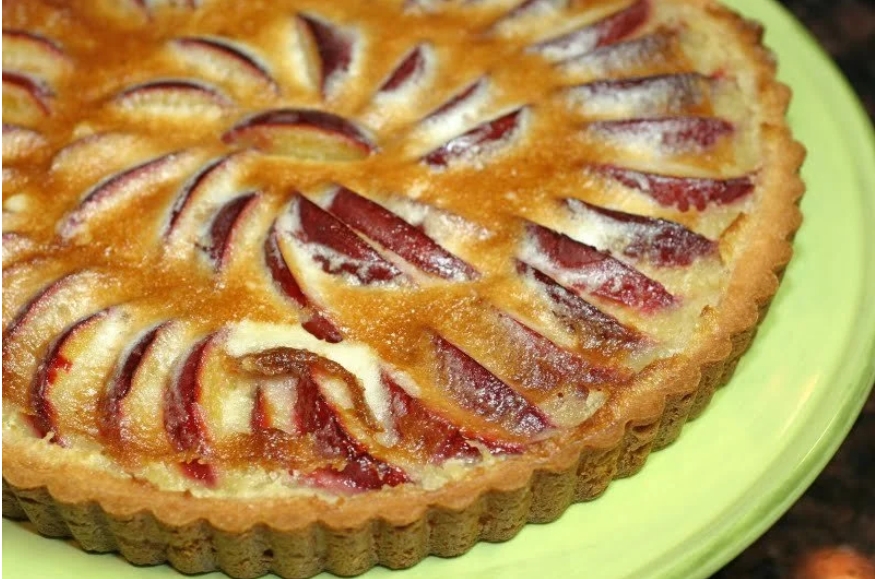
The most requested recipe in internet history is Marian Burros’s recipe for Plum Torte. (That statement may be a slight exageration.)
The New York Times published the recipe every September from 1983 until 1989, when the editors finally decided to put an end to it. The readers rebelled; the editors were flooded with angry letters, and since then the recipe is reprinted every year.
When Alice Waters opened her landmark farm-to-table restaurant Chez Panisse in 1971 and served their first dinner, plum tart was the dessert.
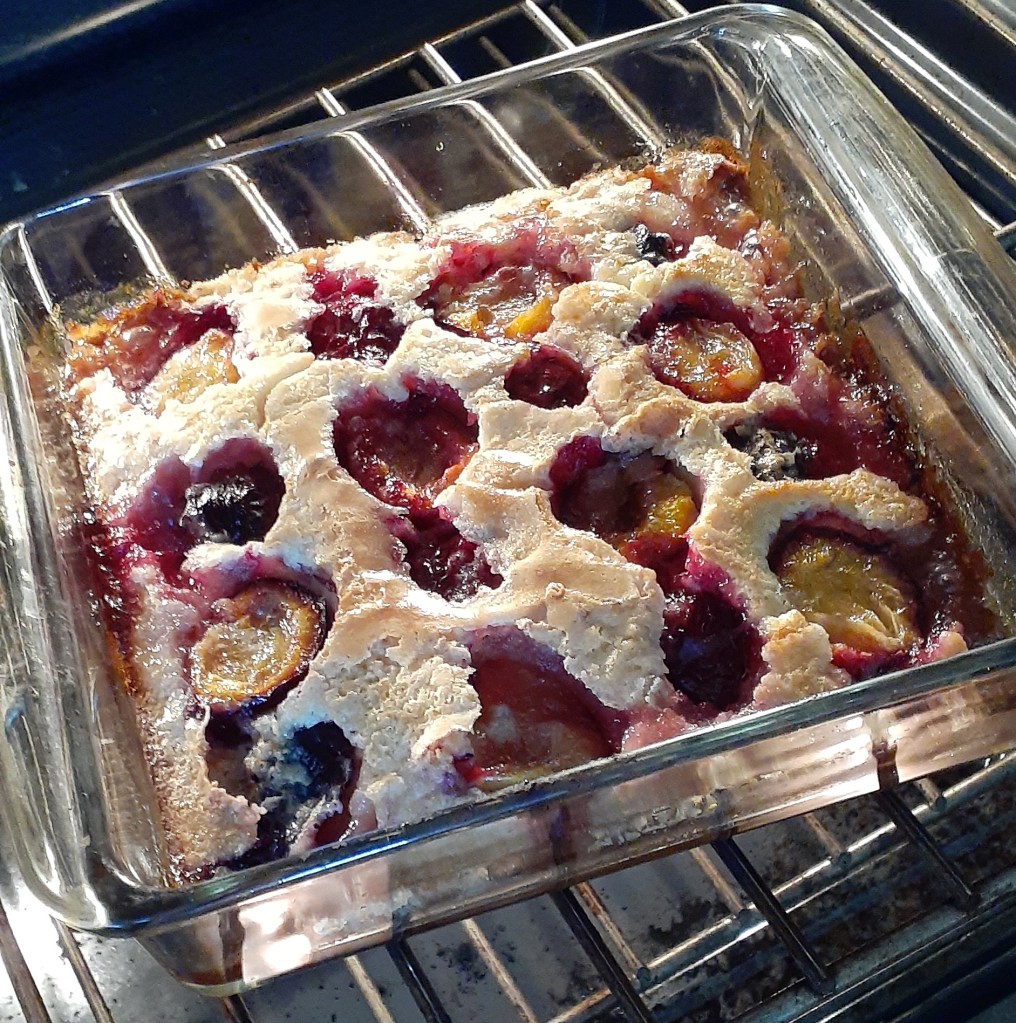
The most requested recipe in our house is Gayle’s Plum Cobbler.
Gayle recorded the recipe in Wenatchee, Washington over 50 years ago, from Ruth Woods. Ruth had brought the recipe to Wenatchee from her home in Texas, where it is known as the “Arkansas Cobbler,” and is more often made with peaches. The cobbler is an easy recipe, sometimes made in an iron skillet. The secret to Gayle’s cobbler’s taste and texture is the temperature change in the oven, which is adjusted mid-way through baking.
The Italian Plum, sometimes known as the Prune Plum, is often disparaged due to its association with, um . . . . , morning habits. But when baked as a breakfast dessert and served with warm cream, it is transformed into an ambrosial fruit worthy of a dessert for the Gods.
Notes:
- For more information about all native plums, as well as entertaining videos, visit the HEPPY Plum Page.
- While many of our native plums bear beautiful, small fruit, these are not true Cherry Plums. The Cherry Plum is native to Southeast Europe and Western Asia. It was brought to North America only after Pissard cloned the Myrobalen and it has since naturalized.
- ‘Spencer Hollywood’ Plum by Arthur Lee Jacobson
- Green-leaved varieties of cherry plums are actively grown. Nurseries commonly use green-leaved cherry plum seedlings as rootstock for grafting various ornamental purple-leaf plums and cultivated stone fruits. Unpruned rootstock suckers often emerge as green-leaved growth.
Sources
The primary reference on purple-leaf plums is ‘Purpleleaf Plums’ by Arthur Lee Jacobson, published in 1991. Jacobson has graciously made abundant information available on his personal web page.
Prunus americana; University of Tx Extension
Chickasaw Plum; USDA, NRCS
All 15 Wild Plums of North America; HEPPY
Those Italian plums you see all over Seattle; use them for Marion Burros Plum Torte
The unidentified, jewel-like plums below were found in a Philadelphia Chinatown market in July, and were sweet, tart, crispy, juicy, and delicious.
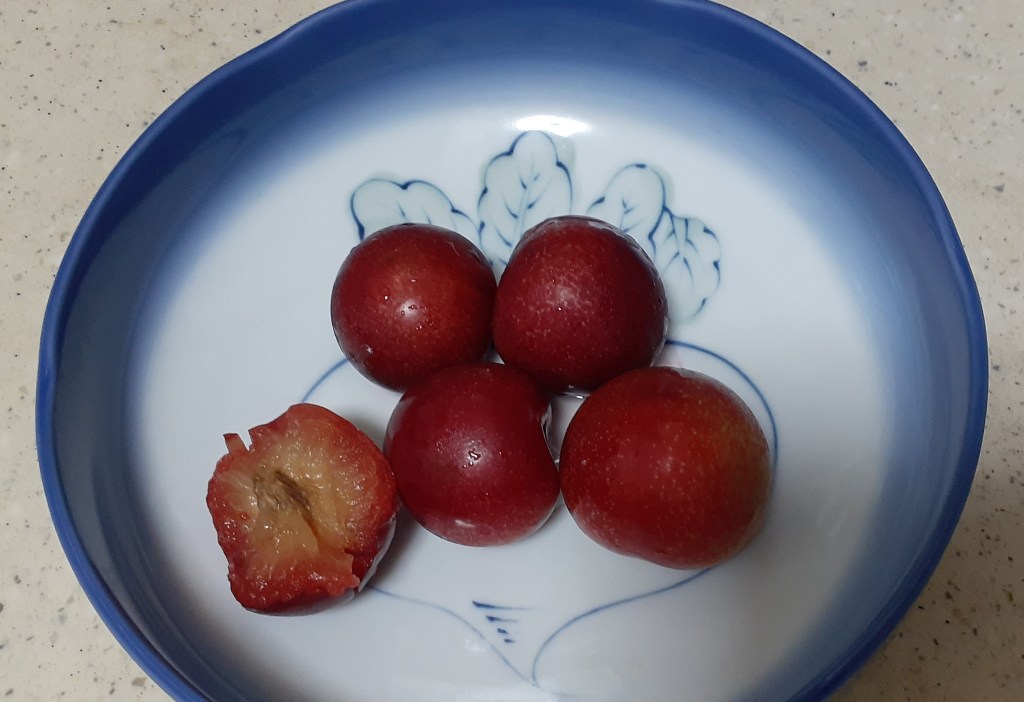
You will not find any of the plums mentioned on this page in your grocery chain stores (with the possible exception of Italian Plums). The fruit may occasionally be found at farm stands or small local markets in season. Trees of some of the species on this page are available to the home orchardist through the nursery trade.
The seeds, stems, leaves, and bark of all plums contain cyanogenic glycosides—specifically amygdalin and prunasin. When these plant parts are chewed, crushed, or wilted, the compounds break down and release toxic hydrogen cyanide.
.

